
In the captivating world of fragrances, where scents evoke memories, emotions, and identities, the perfume bottle stands as more than a mere vessel—it's a masterpiece of design, engineering, and artistry. A custom perfume bottle encapsulates the essence of a brand, transforming a simple container into an icon that graces vanity tables and retail shelves worldwide. At the forefront of this intricate process is Qingdao Huanxi Homeware Co., Ltd, a Chinese manufacturer with over 18 years of expertise in producing premium glass products, including perfume bottles, sprayers, and caps. Based in the bustling port city of Qingdao, Huanxi has carved a niche in the global market by blending traditional craftsmanship with modern innovation, exporting to regions like North America, Europe, and the Middle East. Their state-of-the-art facility, spanning thousands of square meters, churns out high-quality, eco-friendly packaging that meets the demands of luxury brands and emerging perfumers alike.
This article delves into the fascinating journey of a custom perfume bottle from its conceptual inception to its triumphant arrival on store counters. Drawing from Huanxi's proven processes and industry insights, we'll explore each stage, highlighting the blend of creativity, technology, and precision that turns raw materials into elegant artifacts. Whether you're a fragrance enthusiast dreaming up your own scent line or a brand owner seeking bespoke packaging, understanding this journey reveals the magic behind the glass.
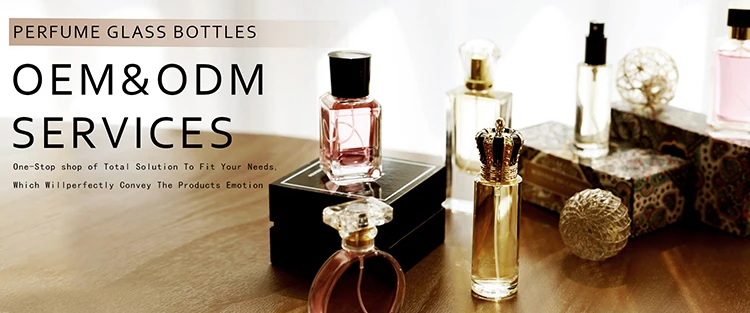
Every custom perfume bottle begins as an idea—a fleeting vision in the mind of a designer, perfumer, or brand strategist. At Huanxi Homeware, this phase is collaborative and client-centric. Founded in 2007, the company has honed a system where clients, from indie startups to multinational corporations, bring their concepts to life through OEM (Original Equipment Manufacturing) and ODM (Original Design Manufacturing) services. Huanxi offers wholesale custom luxury empty glass perfume bottles in sizes ranging from 30ml to 100ml, complete with options for vintage designs, gradient stripes, and tapered shapes.
The process kicks off with brainstorming sessions. Imagine a luxury brand aiming to evoke the serenity of a Mediterranean garden; their bottle might feature soft curves, a sea-blue tint, and intricate etchings of olive branches. Huanxi's design team, armed with CAD software and 3D modeling tools, translates these ideas into digital prototypes. This stage is crucial for feasibility checks—ensuring the design aligns with manufacturing capabilities, such as bottle volume (e.g., 100ml for their popular HX series models) and compatibility with sprayers and caps.
Material considerations come early. Glass, favored for its purity and recyclability, is Huanxi's specialty. They source high-quality soda-lime or borosilicate glass, which offers excellent transparency and resistance to chemical reactions from perfumes' alcohol-based formulas. Eco-friendliness is a priority; Huanxi emphasizes sustainable sourcing, aligning with global trends toward green packaging. As industry experts point out, incorporating recycled glass reduces environmental impact without compromising aesthetics. Once the concept solidifies, sketches evolve into detailed blueprints.
With the design approved, attention turns to raw materials. Perfume bottles demand materials that are inert, durable, and visually stunning. At Huanxi's Qingdao factory, the journey starts in the raw materials warehouse, where silica sand, soda ash, limestone, and cullet (recycled glass) are meticulously inspected.
Silica sand forms the backbone, providing the glassy structure. Soda ash lowers the melting point, while limestone adds stability. Huanxi's commitment to quality means sourcing from certified suppliers, ensuring impurities are minimized to achieve crystal-clear glass. For colored bottles, metal oxides like cobalt for blue or selenium for amber are added, allowing customization that matches brand palettes.
Sustainability shines here. Huanxi integrates recycled glass, which melts at lower temperatures, saving energy. Their facility, equipped with automatic and semi-automatic lines, processes these materials efficiently. As per their website, they continually invest in machinery to enhance production, supporting an output that caters to diverse markets.
Beyond glass, accessories like sprayers and caps require aluminum, plastic, or zinc alloys. Huanxi's aluminum perfume bottles, for instance, offer a lightweight alternative with a premium metallic finish. These materials are chosen for their corrosion resistance and ease of customization, such as magnetic caps that snap securely.
The heart of manufacturing lies in the furnace, where raw materials transform into molten glass. At Huanxi, this occurs in high-temperature tanks reaching 1500°C (2732°F). The batch—a precise mix of ingredients—is fed into the furnace, melting into a viscous liquid free of bubbles and streaks.
Once molten, the glass is ready for forming. Huanxi employs advanced techniques like blow-and-blow or press-and-blow methods, ideal for intricate perfume bottle shapes. In the blow-and-blow process, a gob of molten glass is dropped into a parison mold, where compressed air forms the initial shape. It's then transferred to a final mold for the finishing blow, creating the bottle's body, neck, and base.
Machine automation dominates at Huanxi, with I.S. (Individual Section) machines handling multiple molds simultaneously. This allows for high-volume production—up to 600,000 bottles daily, as inferred from similar facilities. For custom runs, manual blowing might be used for unique designs, where skilled artisans shape the glass with blowpipes, adding artisanal flair.
The molding stage is where design specifics come alive. For Huanxi's round glass empty perfume bottles (e.g., 50ml with magnetic caps), molds are precision-engineered to ensure uniform thickness and smooth surfaces. Challenges like thermal shock are mitigated through controlled cooling, preventing cracks.
As detailed in manufacturing guides, mold making precedes this: Steel or iron molds are crafted based on the blueprint, often using CNC machining for accuracy. Huanxi's expertise ensures molds accommodate features like threaded necks for screw caps or crimp seals for sprayers.
Fresh from the mold, the bottle is hot and fragile. Enter annealing: a gradual cooling process in a lehr oven, where temperatures drop from 600°C to room temperature over hours. This relieves internal stresses, enhancing strength and preventing breakage.
At Huanxi, automated lehrs maintain precise temperature gradients, crucial for high-quality output. Post-annealing, bottles undergo initial inspection. Automated cameras and sensors detect defects like bubbles, cracks, or distortions. Human inspectors handle nuanced checks, ensuring each piece meets ISO standards—though specific certifications like ISO9001 are implied in their operations.
This stage is pivotal for customization viability. Bottles destined for decoration must be flawless, as imperfections amplify under coatings.
Here's where magic happens—transforming plain glass into a branded gem. Huanxi excels in decorative techniques, offering electroplating, spray coating, hot stamping, and more. Their catalog showcases antiqued finishes, iridescent effects, and flocking for a velvety touch.
Spray coating applies colors or gradients, like the popular stripe taper shapes. Electroplating adds metallic sheens—gold, silver, or antique bronze—for luxury appeal. Water transfer printing enables patterns like marble or wood grain, while laser engraving etches logos precisely.
Flocking, a unique method, uses electrostatics to adhere fibers, creating tactile surfaces. Huanxi's inner and outer sprays achieve dual tones, enhancing visual depth.
For eco-conscious brands, Huanxi uses water-based coatings and low-VOC inks. Custom runs might involve silk-screen printing for intricate designs, ensuring durability against wear and chemicals.
A bottle alone isn't complete; it needs a sprayer and cap. Huanxi's sprayers, with patents for fine mist patterns, come in series like 113 (0.13CC dosage) or 110 (0.1CC for delicate mists). These are assembled via crimping or screwing, ensuring leak-proof seals.
Caps, from lightweight plastic to ornate zinc, provide the finishing touch. Models like HX12221 (26.6g, cylindrical) are matched to bottles for aesthetic harmony. Assembly lines at Huanxi use robotic arms for precision, followed by torque testing to verify secure fits.
This stage integrates client specifics—perhaps a magnetic cap for easy access or a child-resistant design.
Rigorous quality control defines Huanxi. Bottles undergo leak tests, drop tests, and chemical compatibility checks.
Random sampling and third-party audits maintain standards. Defective items are recycled, minimizing waste.
Final bottles are packaged in protective cartons, often with custom boxes for retail appeal. Huanxi's logistics network ships globally, with FOB Qingdao terms.
From factory to counter, bottles arrive at perfume houses for filling, labeling, and display.
The journey from concept to finished product is a symphony of innovation and craftsmanship, exemplified by Qingdao Huanxi Homeware Co., Ltd. With their vast array of perfume bottles—from 30ml minis to 100ml statement pieces—they empower brands to create lasting impressions. As the fragrance industry evolves toward sustainability and personalization, companies like Huanxi lead the way, turning glass into gateways of sensory delight.
Contact: Jack Song
Phone: +86-18661792804
Tel: +86-18661792804
Email: jack@hx-candle.com
Add: 230 Changjiang Middle Road, Qingdao, Shandong, China